Welcome to Katie's Travel Blog. This is really Jenny-doesn't-get-to-travel blog where I (mom) keep track of Katie's adventures so I can have some vicarious enjoyment! Here's a look at what one globally-aware kid from little Santa Cruz, California gets to do these days if her mom's willing to keep working!
Showing posts with label 2013. Show all posts

Wednesday, November 6, 2013

PTPI GYF 2013: Let's Get This [Education] Conference Started!

Am I too intense? 
Just like that, she's in Washington D.C. for a week(end) of conferencing and learning.

She spent the night with Sandra, a close family friend, and together they got up at 4am and got it together and out the door to SFO. The flight left at 8am but of course they had to get there early.

I thought I would see not having to worry about driving them, but no. I fretted. Sent this text to Sandra at 4am. Thankfully she messaged back and I tried to return to sleep. I really didn't relax until I saw the pic of Katie at the airport - thank god, they would get on the plane. My work here was done.

They arrived just before 4pm and now things will really get started. Sandra peeled off to go visit an old friend and Katie headed to the Sheraton Crystal City Hotel in Virginia. The conference hits the ground running so of course I haven't heard from her - don't expect to frankly. Tomorrow they start the workshops and then spend the afternoon touring DC - hopefully that storm below won't him them too hard [hilarious, just Googled "big storm to hit DC" and all I get is links to Chris Christie! Let the politics begin!]

Love FlightAware.com. Flight got in early; I think that Jet Stream is kicking in!

Wednesday, November 6, 2013
04:00     Welcome & Orientation
04:30     Delegation Groups - Introductions and Discussion on Importance of Education
06:00     Dinner
07:00     Opening Ceremony
08:30     Delegation Group Discussion: Barriers to Education

Thursday, November 7, 2013
08:30     Global Education Workshops
10:00     Delegation Group Discussion: Workshop Sharing
12:00     Lunch
01:00     D.C. Sightseeing Tours
06:00     Dinner
07:00     Keynote Speaker: Carol Bellamy, former Executive Director of UNICEF
08:30     Delegation Group Discussion: How to Achieve Global Education

Friday, November 8, 2013
08:00     Service Projects in D.C. Area
12:00     Off-site Lunch
01:30     Delegation Group Discussion: How to Achieve Global Education (continued)
04:00     Wrap4Smile Presentation and Project
06:00     Dinner
07:00     Culture 101 Workshops
09:00     Delegation Group Discussion: Preparing your Global Education Action Plan

Saturday, November 9, 2013
09:00     Delegation Group Discussion: Final Preparation of Action Plans
11:00     Delegation Group Presentations
12:00     Lunch
01:00     Presentation and Open Mic Session
04:00     Final Delegation Group Meeting: Reflection and Taking Action
06:30     Closing Dinner, Awards Ceremony, and Dance

Sunday, November 10, 2013           Departures

Sunday, November 3, 2013

PTPI GYF 2013: Washington DC Here She Comes!

Katie's getting ready to head out for this year's PTPI Global Youth Forum leadership conference in our nation's capital. She leaves early Wednesday morning for the four-day event.

From the agenda:
Nelson Mandela once said, “Education is the most powerful weapon you can use to change the world.” We believe that, through your GYF experience, you will return home having a better understanding of the importance of global education, existing barriers to education throughout the world, and strategies to make education a reality for every child, everywhere. The theme of the event is Global Education:  Providing a Vision for the Future!
I'm excited about her looking at education from a global perspective. I'm hoping she discovers how good she has it and at the same time how we are behind.Typically they have students there from other countries and I think they will bring a unique perspective - that of gratitude - for the gift of education which might open my child's eyes a bit. Last time she went, it was a life-changing event for her. I am crossing my fingers it will be similarly moving for her this time.

The prep materials are jammed packed with information and factoids. I'm posting the information here because it's so good and can be used for a reference if you ever want to dig a little into global education. Here's what she's reviewing to prepare. More tomorrow about the agenda.

The Value of Education
Information from Global Partnership for Education
Girls and boys who learn to read, write and count will provide a better future for their families and countries. With improved education, so many other areas are positively affected. In short, education has the power to make the world a better place. Education is more than reading, writing, and arithmetic. It is one of the most important investments a country can make in its people and its future and is critical to reducing poverty and inequality:

·        Education gives people critical skills and tools to help them better provide for themselves and their children

·       
Education helps people work better and can create opportunities for sustainable and viable economic growth now and into the future

·       
Education helps fight the spread of HIV/AIDS and other diseases, reduces mother and child mortality and helps improve health

·       
Education encourages transparency, good governance, stability and helps fight against corruption.

The impact of investment in education is profound: education results in raising income, improving health, promoting gender equality, mitigating climate change, and reducing poverty.


Here is a breakdown of the impact of education on people’s lives.

Income & Growth Education is the key to unlocking a country's potential for economic growth:
·        If all students in low income countries left school with basic reading skills 171 million people could be lifted out of poverty. This is equal to a 12% cut in global poverty. (EFA GMR, UNESCO)
·        One extra year of schooling increases an individual's earnings by up to 10%. (EFA GMR, UNESCO)
·        Wages, agricultural income and productivity – all critical for reducing poverty – are higher where women involved in agriculture receive a better education. (EFA GMR, UNESCO )
·        Each additional year of schooling raises average annual gross domestic product (GDP) growth by 0.37%. (EFA GMR, UNESCO)
·        An increase of one standard deviation in student scores on international assessments of literacy and mathematics is associated with a 2% increase in annual GDP per capita growth. (World Bank)
Health The most effective investment for achieving long-term health benefits is educating girls and women. Girls' education is often the single most powerful factor affecting health outcomes such as infant mortality, maternal mortality, the propensity of mothers to seek modern birth options, the availability of those options because more and better trained birth attendants are available, the rate of risky teenage births, and the number of children she will have.
·        Each extra year of a mother's schooling reduces the probability of infant mortality by 5% to 10%. (EFA GMR, UNESCO)
·        A child whose mother can read is 50% more likely to live past age 5. (EFA GMR, UNESCO)
·        Over the past four decades, the global increase in women's education has prevented more than 4 million child deaths. (Lancet Study)
·        In sub-Saharan Africa, approximately 1.8 million children's lives could be saved if their mothers had at least secondary education. (EFA GMR 2011, UNESCO)
·        Chronically malnourished children are 20 % less literate (Save the Children Report)

Gender Equality Education is key to women's rights, self-expression and civic engagement:
·        One additional year of school reduces the probability of becoming a mother by 7.3 % for women who have completed at least primary education. (World Bank)
·        Investing in girls education could boost sub-Saharan Africa agricultural output by 25%. (IFPRI)
·        One additional school year can increase a woman's earnings by 10% to 20%. (World Bank)
·        Increasing the number of women with secondary education by 1% can increase annual per capita economic growth by 0.3%. (World Bank)
·        Some countries lose more than $1 billion a year by failing to educate girls to the same level as boys (Plan International. "Paying the price. The economic cost of failing to educate girls")
Other Education has an impact on many other areas such as:
Peace and Democracy

·        If the enrollment rate for secondary schooling is 10 percentage points higher than the average, the risk of war is reduced by about 3 percentage points (World Bank, Understanding Civil War)
·        Literate people are more likely to participate in the democratic process and exercise their civil rights. (UNESCO)
·        Education has been identified as one of the indicators or conditions for determining peace within societies. (UNESCO)

Agricultural Outputs
·        Investing in girls education could boost sub-Saharan Africa agricultural output by 25%. (IFPRI)
·        Wages, agricultural income and productivity – all critical for reducing poverty – are higher where women involved in agriculture receive a better education. (EFA GMR, UNESCO)

The Millennium Declaration & Development Goals: A Blueprint for Progress
Source: www.un.org/millenniumgoals
In September of 2000 the largest gathering of world leaders in human history gathered for the Millennium Summit at United Nations headquarters in New York. In that pivotal year, representatives from 189 Member States of the United Nations met to reflect on their common destiny. The nations were interconnected as never before, with increased globalization promising faster growth, higher living standards and new opportunities.
Yet their citizens’ lives were starkly disparate.  As some States looked ahead to prosperity and global cooperation, many barely had a future, being mired in miserable, unending conditions of poverty, conflict and a degraded environment. Some 1.1 billion people were – and still are – forced to live on less than $1 a day, and 30 per cent of these are children. Even in the world’s richest countries, one in every six children still lives below the national poverty line.
A further look at humanity’s challenges: Almost 11 million children, more than 29,000 a day, die before the age of five, mostly from preventable causes. Those that survive suffer other consequences: malnutrition leading to stunting and disability, a lack of access to health care and education, and an increased risk of suffering from exploitation, violence and HIV/AIDS.
A UNICEF-sponsored study by the University of Bristol and the London School of Economics concluded that over 1 billion children –more than half the children in developing countries – suffer from at least one form of severe deprivation. Such as:
·        One in every three children in the developing world – over 500 million children – has no access whatsoever to sanitation facilities; one in five has no access to safe water. 

·        Over 140 million children in developing countries – 13 per cent of those aged 7 to 18 years – have never attended school. This rate is 32 per cent among girls in sub-Saharan Africa, where 27 per cent of boys also miss out on schooling, and 33 per cent among rural children in the Middle East and North Africa.

·        AIDS has killed one or both parents of an estimated 15 million children worldwide; 12 million of these are in sub-Saharan Africa. The number of orphaned children is projected to exceed 25 million by the end of the decade. (UNAIDS, July 2004)
To begin addressing these crises back in 2000, the convened leaders set down the Millennium Declaration, a series of collective priorities for peace and security, poverty reduction, the environment and human rights – essential steps for the advancement of humankind, as well as for the immediate survival for a significant portion of it. Human development, they agreed, is the key to sustaining social and economic progress in all countries, as well as contributing to global security. 
But how would the world community achieve these priorities? Following further meetings with many world agencies, the delegation also drew up a blueprint for a better future: the Millennium Development Goals. By 2015, the leaders pledged, the world would achieve measurable improvements in the most critical areas of human development. The goals establish yardsticks for measuring these results, not just for developing countries but for countries that help to fund development programmes and for the multilateral institutions, like the World Bank or the United Nations Development Programme, that help countries implement them.
The Millennium Development Goals Set Priorities for Children
Though the Goals are for all humankind, they are primarily about children. Why:
·        Because six of the eight goals relate directly to children. Meeting the last two will also make critical improvements in their lives.

·        Because meeting the Goals is most critical for children. Children are most vulnerable when people lack essentials like food, water, sanitation and health care. They are the first to die when basic needs are not met.

·        Because children have rights. Each child is born with the right to survival, food and nutrition, health and shelter, an education, and to participation, equality and protection – rights agreed to, among others, in the 1989 international human rights treaty, the Convention on the Rights of the Child.  The Convention has been ratified by 192 states, every country in the world except two. The Millennium Development Goals must be met for these basic human rights to be realized.

·        Because reducing poverty starts with children. Helping children reach their full potential is also investing in the very progress of humanity. For it is in the crucial first years that interventions make the biggest difference in a child’s physical, intellectual and emotional development. And investing in children means achieving development goals faster, as children constitute a large percentage of the world’s poor.

Barriers to Education
Children all over the world are prevented from receiving an education. During one of your first sessions at the GYF, you will be discussing the Barriers to Education. Be prepared to share your thoughts on the below. Some of the barriers that exist include (see graphic). 


Sunday, August 11, 2013

Something Different: Junior Statesmen California Institute on Leadership and Politics

Did I mention, that's my old dorm!?!
Katie and Emelia started a new adventure today.

This is the first time, ever, that Katie has gone on one of these adventures with a friend. Emelia is actually a neighborhood friend who lives close and is nearly the same age as Katie (her birthday is the day after Katie's) so they mesh together really nicely.

The Institute is at UC Davis, my old alma mater, and they are staying in the Bixby dorms - my old dorm! It was awesome going back to the building and watching them get all excited about setting up their temporary home. 

The dorms, built in 1962 (ironically the year I was born) look the same with a few tiny upgrades (or distractions depending on how you look at it - they really messed up how the beds fit in the rooms with the addition of new heaters in front of the windows). 

Unbeknownst to me, Katie packed dorm decorations and a fan ("In case it gets hot mom") and so she had plenty to do upon arrival. I got them there nice and early so they had plenty of time to nest.


I don't know, do they look happy?
I hope they have a terrific time. It's going to go pretty quickly; I pick them up on Wednesday afternoon. If they have a good JSA experience, they can join local clubs at their high schools and attend more events in the future. Not familiar with JSA? From their website:
     The mission of the Junior State of America and the Junior Statesmen Foundation (JSA) is to strengthen American democracy by educating and preparing high school students for life-long involvement and responsible leadership in a democratic society. 
  In the student-run Junior State and at JSA summer schools and summer institutes, participants learn statesmanship as they engage in political discourse. They cultivate democratic leadership skills, challenge one another to think critically, advocate their own opinions, develop respect for opposing views and learn to rise above self-interest to promote the public good.
Here's the day's agenda: 

Time
Activity
9:00 am – 11:30 am
Registration – Segundo Service Center
11:30 am – 12:30 pm
Opening Session - Wellman 106
12:30 pm – 2:00 pm
Lunch – Segundo Dining Commons
2:00 pm – 3:30 pm
Project Citizen Workshop – Bixby Hall Lounge
3:30 pm – 5:00 pm
Group Project Planning – Bixby Hall Lounge
5:00 pm – 7:00 pm
Dinner – Segundo Dining Commons
7:00 pm – 9:00 pm
Documentary/Discussion – Wellman 106
9:00pm - 10:00 pm
Free time / Work on Group Project
10:00 pm
Floor Meeting
11:00 pm
Curfew

Katie already decorating in her mind.
Emelia looking for the bathroom.


Thursday, July 18, 2013

Day 16: Planes, Planes and More Planes - The Long Journey Home

Froggy has been waiting for Katie
to come home for weeks now.
If I have done my calculations correctly, as I publish this blog at 9am Pacific Time, they will be dragging their bodies out of bed (if they even went to bed) to get packed and make their way to the airport in Cairns. It will be 2am in Australia. 

Their flight from Cairns to Brisbane (Qantas 799) is scheduled to depart at 5:30am, but People to People always likes their delegates to be there three hours before a flight. They fly one hour and forty-five minutes to Brisbane and then have a three hour layover before their next flight to Los Angeles (Qantas 015). Flight 0150 is a nearly 13 hour flight. 

They arrive in LA at 6:30 am (now your brain has to do some work - they arrive here before they left in the international dateline time/space continuum). They proceed through their Groundhog Day experience catching a plane in LA at 12:05pm (that's a horrible five hour layover) to arrive in SF at 1:20pm on the very same day (or tomorrow for us). 

I expect texting (if she's conscious) while at the airports. Could start really early tomorrow morning. In the meantime, I need to go buy some groceries - especially fresh fruit - that's always what's she's craving after these trips.

Here's to a safe trip home for the kidlets and a weekend full of wonderful stories.

UPDATE: Here they come!


From the People to People Itinerary:
  • Say farewell to beautiful Australia and board the motorcoach to the airport for your return flight to the United States.
  • Be prepared to declare! You will need to declare your farm stay on your arrival card. This is an important precautionary measure to prevent the spread of disease and pests.
  • On your flight home, reflect on your journey, your new understanding of New Zealand and Australian culture, and expanded horizons as a Student Ambassador. Welcome home!


Wednesday, July 17, 2013

Day 15: Their Last Day Down Under Ends With a Hop, Hug, and Cuddle!

If they aren't suffering from incredible sunburn, today they will delight in the oohs and ahhs of Australia's more cuddly nature.

I was hoping someone might have posted a few pics last night from yesterday's adventure, but I am pretty sure they don't have wi-fi and won't until the airport tomorrow.

It looks like they will finally do their service project (although they are going to be so tired, I hope they aren't responsible for anything too important!). The itinerary says restoring the rain forest. Maybe planting trees?

They they get a taste of Aboriginal culture with a little dancing (see videos below) and they get to throw a boomerang. How many of those do you think will come home - to California?!

Finally, they get to see koalas, kangaroos and wombats at a wildlife sanctuary (there are several, maybe this one or here?). I know Katie's been waiting for this. I honestly don't know how they are going to fit all this in!

The leave for Brisbane EARLY in the morning on Friday (their Friday which is our Thursday) and start their flight home.

From the People to People Itinerary:
  • Walk on the wild side when you get up close and personal with crocodiles and learn more about these amazing creatures.
  • Participate in a unique service project; restoring world heritage rainforest to its original state.
  • Be immersed in the Aboriginal culture with a demonstration of Aboriginal traditional dance, boomerang and spear throwing, as well as an introduction to Aboriginal history.
  • Ride through the rainforest in a World War II amphibious vehicle, an Army Duck, which can traverse land and water. Officially spelled DUKW, Army Ducks were used in Australia by the U.S. Military during WWII.
  • Encounter Australia’s unique fauna, such as koalas, kangaroos, and wombats at a wildlife sanctuary.
  • Cuddle a koala and have your photo taken!
  • Participate in an ‘Aussie’ bush dance. 
Here's an Aborginal Dance:


And an Aussie Bush Dance (that looks a lot like something Billy Ray Cyrus might do!)

Tuesday, July 16, 2013

Day 14: California Kids Go Snorkeling in the Great Barrier Reef

There's not much to say about today's events other than OHMIGOD!

They will be snorkeling on the Great Barrier Reef.

This means I was up at 4am with my typical anxiety because she's going to be in the water (this is a lifelong condition I've had and while my kid is an excellent swimmer, I still choose to be a complete mental patient and worry about these things). Mind you they won't be in the water until about 4pm our time, but why should I waste my time sleeping when I could be up worrying about something I have absolutely no control over!?

To combat my frailty, I've decided to imagine snorkeling with her later today. I will get my work done as fast as I can and then maybe stream a video on Netflix like The Reef, oh wait, not that one, maybe Grainger's World - oh good lord, NOT that one - okay, okay, I guess there aren't a lot of streaming movies to watch. I guess this will do.

So we can all imagine snorkeling later today, I've found a few photos to share. Hopefully this will get all of us off to a great start today.

Note: the water temperature for their dive was 72 degrees. Not too shabby.

PS: we should be grateful our kids are getting to see the reef: one of the seven wonders of the natural world. There are several threats to the health of the reef and speculation it could be in danger of surviving.

From the People to People Itinerary:
  • Take the plunge and snorkel the Great Barrier Reef, coming into contact with brightly colored tropical fish, giant clams, and an amazing array of soft and hard coral of every imaginable color.
  • Got questions about the reef or its inhabitants? Ask away! You’ll get answers from the marine biologist that exclusively joins your delegation for this experience. 


Monday, July 15, 2013

Day 13: Sand Tobogganing, the Tasman Sea and Off to Cairns

Wow, she does look kinda waxy!
Today they take a coach from Shoal Bay back to the airport in Sydney.

They can fly to Cairns at 1:30 and arrive at 4:30 where tomorrow, they will snorkel in the Great Barrier Reef. I wasn't sure if they would hit the dunes yesterday or today but the itinerary said today. Turns out it was yesterday and Sheila posted a few great shots!

She also shared a few other photos from the last few days. From the climbing and repelling trip to the Antarctic Center and fireworks in Sydney. These kids are living large and will have stories to tell us through Christmas! They only have a few more days!

The photos below are Sheila's pics except the one I swiped from Eloise's Instagram on the right!

From the People to People Itinerary:

Welcome to Cairns, a coastal cosmopolitan city nestled in tropical northern Queensland amid two of Australia’s most treasured World Heritage destinations, the Wet Tropics Rainforest and the Great Barrier Reef.
  • Challenge yourself to try sand boarding and race down the sand dunes that can be over 90 feet high!
  • Travel back to Sydney to board your flight to Cairns this evening.
  • Interact with local Aussie families over dinner and enjoy this unique opportunity to be immersed in local culture and learn about life in Australia. 
At the Dunes. Some of Mad Max was filmed here Sheila reports.
How fun is that!?!
At the Antarctic Center. 
Just before the repel down the mountain!
I have no idea where this is...
Fireworks over Sydney Harbor.


Sunday, July 14, 2013

Day 12: Finding Nemo in Shoal Bay, Australia


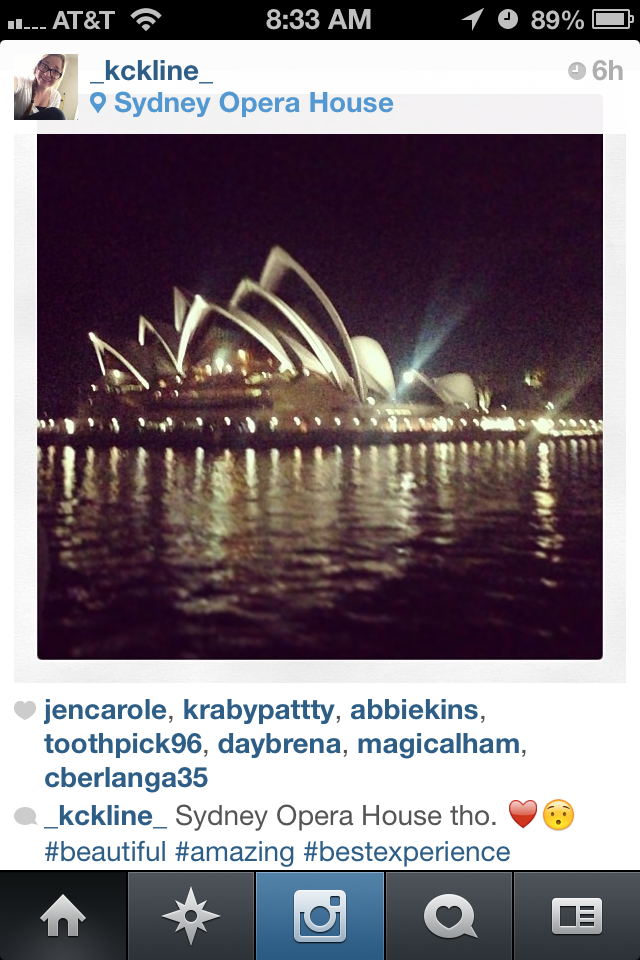
I swiped Casey's pic off Instagram this morning because it was so good and I really loved the words she used to describe their experience: beautiful, amazing, bestexperience. What else could we want for them?

The kids are leaving Sydney this morning and heading the Port Stephens and the Shoal Bay Resort and Spa. (Again, really!?!)

Provided they have one ounce of time, the place looks fantastic with a pool and lots of areas to explore.

But first, they will check out the Port Stephens Harbor and learn about the environment. It looks like a place rich with sea life and incredible views. They will get to take a cruise to look for dolphins (I hope they see some) and other wildlife - maybe a whale or two? We are in Nemo Country folks!

They'll have wi-fi at the hotel tonight so hopefully we'll get some pictures and phone calls.

UPDATE: I got one tiny text from Katie at 2pm (this time I was out of range) and she said "Having breakfast, the Opera House was amazing!"

From the People to People Itinerary:
Shoal Bay - I think the resort is there in the center somewhere.
They start seeing critters today and have to big snorkel on the Barrier Reef in two more days!


Saturday, July 13, 2013

Day 11: Dog-Tired, Today They Learn Football and Cricket and Visit the Sydney Opera House

Weird face. Casey looks happy!
Got a call from Katie a little after noon - morning her time - and she sounded wiped out! I guess they got sleep last night but the two nights before, not so much.

They toured the aquarium last night and she said, very deadpan, "Great. Fish." Of course that's the one thing we have plenty of around here.

The other thing she said was hard was the food. I guess they have all gained weight (so they think, their clothes aren't fitting all that well) because most of the meals have been fried food and dessert. She didn't complain about it being particularly bad food, just really fattening. I assured her vacation weight comes off pretty easily when she gets back home.

They got to see fireworks last night over the harbor. They look a lot better than the fireworks we saw on July 4th. She mentioned that first thing so it must have been exciting.

Today they are going to do "something sporty" she said with little enthusiasm. Did I mention how tired she sounded? Looks like its some Australian rules football (the ball is super weird - it's not like American football or soccer) and cricket. It says they will be playing with some Aussies. After the "big flirt" with the New Zealand boys, this could be good!

She was excited they end up today at the Opera House. It looks like a dinner cruise too. And then hopefully, another good night's sleep.

I think this is at the airport waiting to go to Sydney.
"Great. Fish."


From the People to People Itinerary:
  1. Sport is an important aspect to the Australian culture and lifestyle. Today have the unique opportunity to learn about some of the most popular Australian sports; Aussie rules football and cricket. After learning the basics, you will have the chance to try and play them with some local Aussies!
  • Examine and handle exquisite opal, Australia’s national gemstone, during a cutting and polishing demonstration at an opal establishment.
  • Get a backstage pass to the world-famous Sydney Opera House. Enter areas that are not accessible to the public during an exclusive guided orientation of this iconic facility, a masterpiece of late-modern architecture.
  • Enjoy a dinner cruise on the Harbour, with Sydney’s skyline as your spectacular backdrop.
This is pretty cool. This guy mines opals about five months out of the year. This is his camp. His blog is interesting and tells his story and has some examples of the opals he mines. Do you know what a Dunny is?